
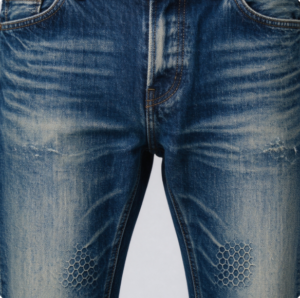
When people fall in love with jeans, what draws them in most is the unique washed look — soft pale blue, sharp whiskers around the crotch, honeycomb fading at the back knee, cloudy monkey marks on thighs and distressed worn textures. Many customers treat washing as a simple “dye removal” step, yet denim washing is a balanced craft combining chemistry, machinery and manual finishing. The same raw fabric can turn into completely different styles under different wash recipes.
Wash development sits at the final creative stage of denim production. It defines the personality of jeans. Before jumping into different wash types, one rule must be kept in mind: Yarn and fabric set the upper limit; washing brings the effect out. A tight high-density compact-spun fabric will never get the same bold contrast as loose ring-spun slub denim, no matter how strong the wash formula is.
The most basic and widely used wash. It removes residual size, loose surface indigo and softens the fabric. Fading is subtle and uniform, with low risk of shade variation. Best for: Basic everyday jeans, stock styles, orders requiring stable mass production. Character: Clean, mild, consistent pale indigo without heavy distressing.
The mainstream eco-friendly wash today. Cellulase enzymes gently eat away the cotton fibre surface, softly abrading the indigo layer. It delivers natural, even fading and improves handfeel greatly. Enzyme wash can be adjusted from light enzyme to heavy enzyme according to target contrast. It is compatible with hand brush, whisker and laser marking. Best for: Most casual vintage styles, mid-weight ring-spun denim.
Natural pumice stones tumble together with garments inside the washer. Continuous impact and friction create cloudy, mottled faded texture. Enzyme stone wash mixes enzyme and stones for softer, more controllable results compared with pure stone wash. Best for: Classic retro denim, workwear styles, obvious vintage worn-in look. Note: Too many stones or long tumble time may cause seam damage, broken stitches or fabric holes.
Uses bleaching agent (chlorine or oxygen bleach) to oxidise indigo dye and lighten the colour drastically. It turns deep indigo into light sky blue or grey-blue. Oxygen bleach is milder, safer for stretch denim; chlorine bleach gives stronger fade but is aggressive to spandex. Best for: Pale fashion denim, clean light-wash fashion jeans.
Strong alkaline auxiliaries attack the cotton surface to create a heavily aged, muddy dirty vintage effect. Chemical stone wash adds pumice for more uneven, worn mottles. Best for: Rugged workwear, heavy dirty vintage look. Limitation: Not suitable for high-stretch styles, easy to lose elasticity.
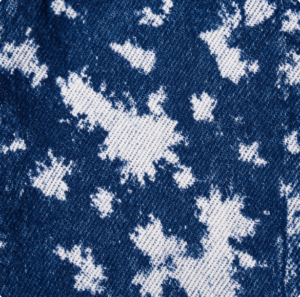
Famous for irregular white snowflake mottles all over the garment. Traditional acid wash uses pumice soaked with potassium permanganate. Today most factories switch to ozone or laser alternatives for environmental compliance. Best for: Statement fashion styles, retro 90s denim.
Waterless or low-water fading technology. Indigo is decolourised by ozone gas inside a closed chamber. It saves massive water and chemicals, with less wastewater discharge. Fading is soft and diffused. Best for: Sustainable brands, clean light washes, minimal fashion denim.
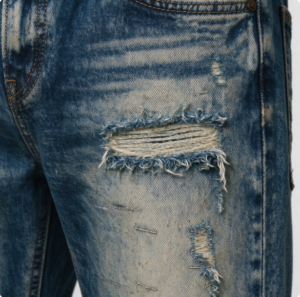
These are the details that make premium denim stand out, applied after base washing or before final rinse.
Workers manually rub designated areas (front thigh, pocket edge, waistband) with abrasive pads to create gradual faded streaks. The transition is soft and organic, hard to replicate fully by machine.
The core process for high-contrast whiskers and monkey marks. Mist of PP solution is sprayed on pre-set folded or masked areas. It oxidises indigo quickly to form bright white faded lines, then neutralised later to stop over-reaction.
Important: Over-spray leads to brown stains if neutralisation is incomplete.
High-pressure air carries fine sand to blast fabric locally for sharp bright white marks. Due to occupational health regulations, sandblast is restricted or banned in many regions now. Laser marking is the common replacement.
Contactless digital marking. The laser burns away the indigo layer precisely following digital patterns: whiskers, honeycombs, logos, scratch marks and even custom graphics. Advantages: Repeatable for bulk production, eco-friendly, zero sand dust, adjustable contrast. Widely adopted now for both basic and high-end lines.
Artificial damage effect: fraying, ripped holes, scrapes, cuts and repair stitching. Usually combined with enzyme or dirty wash for a naturally worn destroyed look.
After all fading steps, re-dye the garment with a secondary colour: black, grey, charcoal, taupe, brown. Known as tint or over-dye. It changes the base blue tone, creating fashion colours such as blackened blue, grey faded denim.
Global denim brands are pushing low-impact washing: ozone, laser, foam wash, low-chemical auxiliaries, water-recycling wash systems. Many buyers reject traditional sandblast and heavy chlorine processes for audit and ESG requirements. Wash recipes now are not only about visual effect, but also environmental compliance.
Yarn builds the fibre, fabric builds the skeleton, and wash brings denim alive. Washing is not just fading colour away; it is controlled, repeatable artistry. A good wash master understands how fabric reacts to every chemical, stone and spray. When you master wash logic, you can communicate clearly with wash plants, reduce revision cycles and deliver the exact vintage, clean, rugged or fashion look your customers want.